
.webp&w=3840&q=75)
Indonesia's Renewable Energy Potential and Challenges
By Chandra Asri Group Editorial Team
26-02-2026
As an archipelagic nation with abundant resources, Indonesia has significant renewable energy potential. Several alternative energies that can be developed are solar, water, wind, and bioenergy.
However, how huge is Indonesia's renewable energy potential? This article discusses the potential mapping and the challenges in the development. So, read the complete information below.
Indonesia’s Renewable Energy Potential
Indonesia is one of the Southeast Asian countries with rapid economic growth. This aligns with the increasing energy needs. That’s why our government sets a sustainable target to fulfill net-zero emissions by 2060.
The General Secretary of the Ministry of Energy and Mineral Resources (ESDM), Rida Mulyana, as quoted in the press release (04/02/2023), explained that we have significant potential for new and renewable energy.
This potential is supported by sustainable solar, wind, bioenergy, geothermal, and hydropower. Our ocean is also prospective for developing renewable energy.
Rida Mulyana added that the installed capacity of the power plants in Indonesia reached 81.2 GW in 2022, while the potential for expansion is about 3,700 GW.
Furthermore, the International Energy Agency (IEA) revealed that 60% of the electricity in Indonesia is from coal-based power plants, and 20% is from natural gas.
The fact is that our renewable energy sources are massive. Therefore, our government carries out some efforts to develop them, one of which is targeting 23% of the renewable energy market share in the electricity mix in 2025.
Read also: What Is Clean Energy? Benefits, Types, and Examples
The Renewable Energy Potential According to the Portion of Each Energy
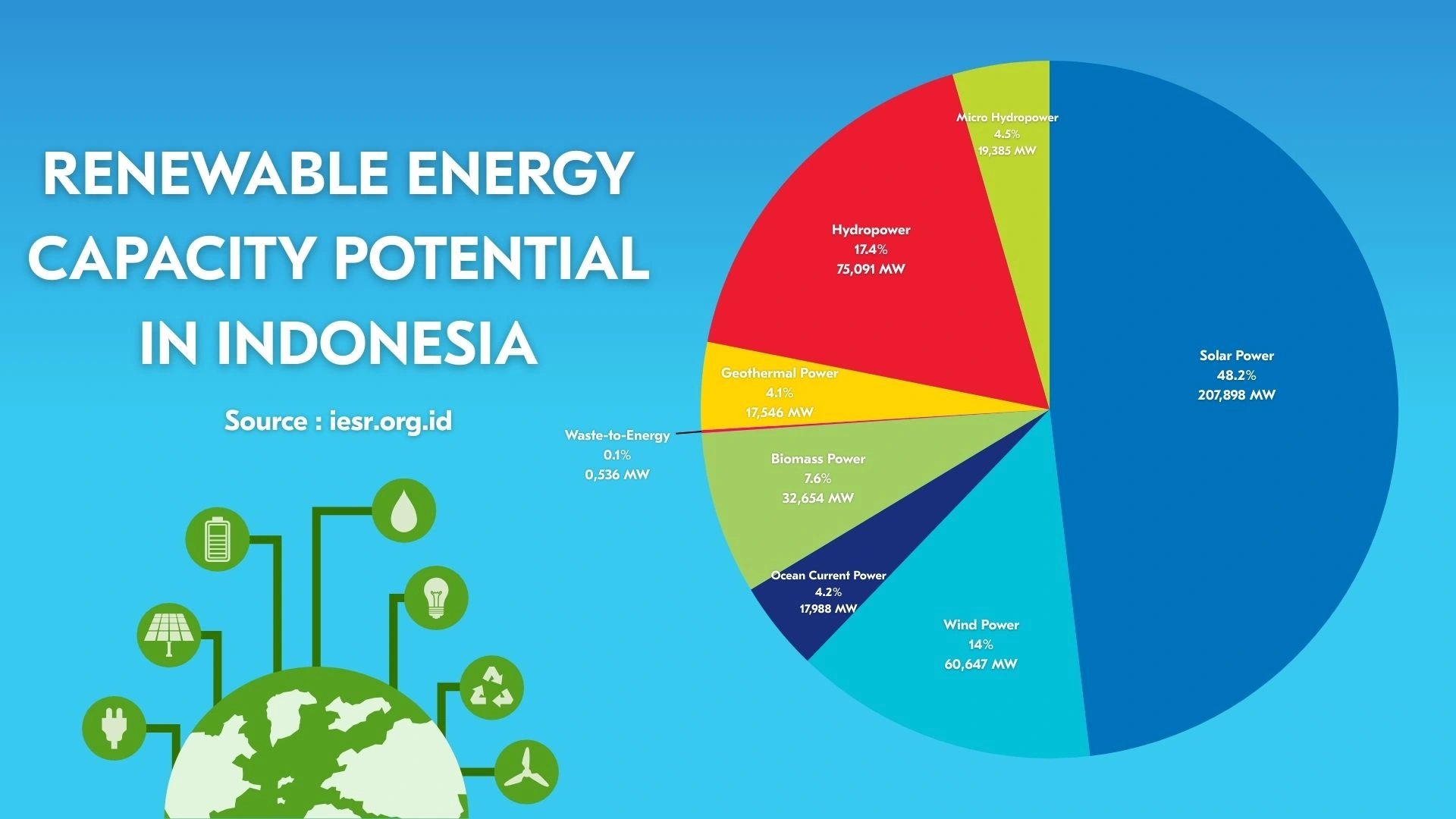
As explained before, Indonesia’s renewable energy potential is pretty huge. According to the Institute for Essential Service Reform (IESR), solar energy has the greatest potential based on the technology, which is about 48.2%.
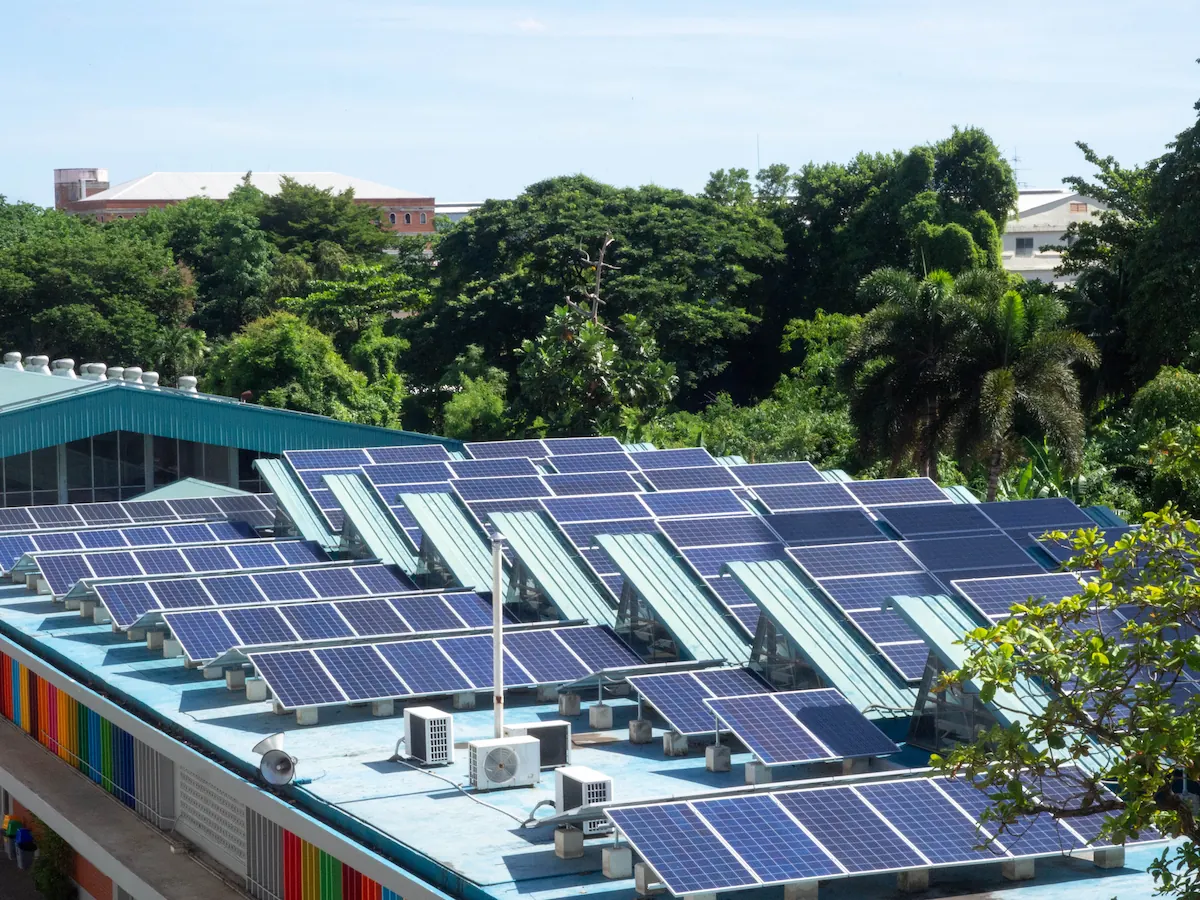
This is because Indonesia is located on the equator with higher sun exposure compared to subtropical countries. Installation is also quite easy and comes in various types, such as floating solar panels and rooftop solar panels.
Regarding solar panels, Chandra Asri Group, as #YourGrowthPartner, through Krakatau Chandra Energi, offers energy solutions in the form of off-grid, on-grid, and hybrid solar panels.
Off-grid solar panels use batteries to store energy; on-grid panels are connected directly to the electricity grid without batteries, while hybrid panels are a combination of both. Chandra Asri Group also built a 102 kWp rooftop solar power plant in July 2020 on the Krakatau Chandra Energi main station.
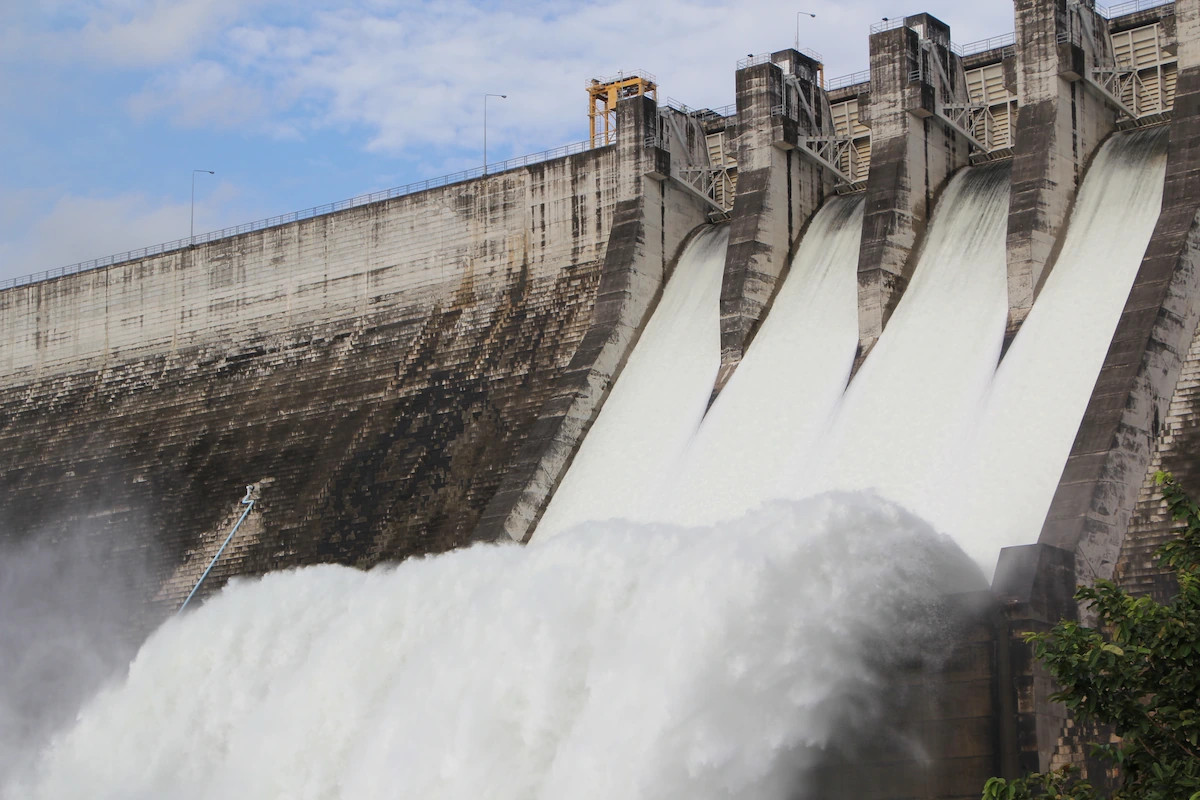
In addition to solar power plants, Indonesia also has abundant potential in water resources, so hydroelectric power plants can also be a renewable energy option.
The Directorate General of Water Resources of the Ministry of Public Works explained that the total potential of water resources in Indonesia reaches 3.9 trillion m³. However, only about 15 billion m³ has been managed. In fact, the potential of hydroelectric power plants in Indonesia reaches 75 GW.
Regarding the share of hydroelectric power plants in electricity production, the IEA explains that the production in 2023 reached 24,590 GWh, greater than solar panels at only 713 GWh and wind energy at around 481 GWh.
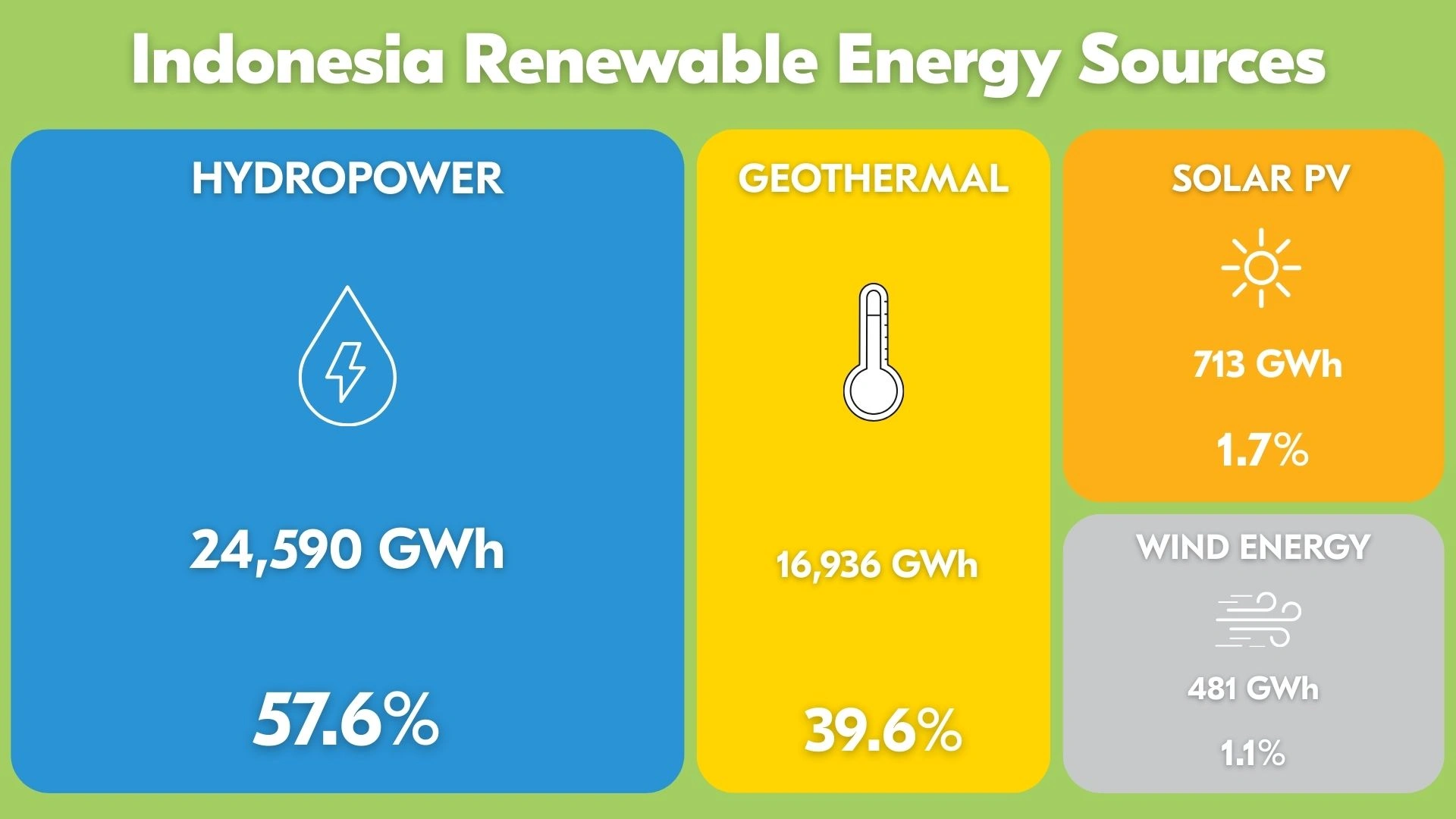
The data also shows that it is visible that geothermal energy also has a promising prospect. It shows that geothermal energy produces electricity of 16,936 GWh, or about 39.6% of the total renewable electricity production.
Overall, it can be concluded that Indonesia’s renewable energy potential is promising to be an alternative to accomplish net-zero emissions and not fully rely on fossil energy.
Read also: 6 Advantages of Renewable Energy and Its Global Potential
Challenges in Indonesia’s Renewable Energy Development
Indonesia has a big potential to leverage renewable energy. The Institute for Energy Economics and Financial Analysis (IEEFA) mentioned that Indonesia plans to install 42.6 GW of renewable energy by 2034, dominated by solar panels.
Therefore, the government and other stakeholders must accelerate investment in renewable energy technologies. To achieve the target of 75 GW of renewable energy capacity by 2040, Indonesia needs to install at least 5 GW of renewable energy annually for 15 years.
However, its development still faces various challenges, such as low awareness of the potential for clean energy in Indonesia, land availability constraints, and high operational costs.
According to the International Energy Agency (IEA), Indonesia needs to enhance its framework for investing in renewable energy and implement reforms that draw in more private capital in order to promote a sustainable economy.
Now, what can stakeholders and the government do to support the potential of renewable energy? They can start investing in solar panel projects as well as prepare a transparent tender process and commercially oriented contract offers for renewable energy projects.
For long-term value and outcomes, they can also concentrate project contracts on financially reliable public authorities.
That is the information about Indonesia’s renewable energy potential you can learn. In conclusion, clean energy, such as solar and water energy, can be an alternative to fossil energy, contributing to carbon emissions.
If your company plans to install solar panels, let Chandra Asri Group and Krakatau Chandra Energi handle it! We provide various types of solar panels based on your business.
So, make sure to entrust your energy needs to Chandra Asri Group and Krakatau Chandra Energy!
Read also: 7 Examples of Electrical Energy and How to Generate It
.png&w=3840&q=75)