
29-06-2026
Energy Solutions for Singapore: How It Secures Energy Supply
By Chandra Asri Group Editorial Team
As an industry-heavy country, Singapore consumes a high amount of energy annually. Many parties should be concerned about this to secure the energy supply in the future and lower emissions.
This article discusses energy solutions for Singapore, including solar PV, and the Singapore Green Plan 2030. Read this article until the end to learn more.
Singapore Energy Consumption
The city-state of Singapore is located at the southernmost point of the Malay Peninsula. It possesses the largest port in Southeast Asia and one of the busiest worldwide.
As the most developed economy in Southeast Asia, Singapore is frequently discussed alongside other rapidly industrializing Asian nations, such as South Korea and Taiwan.
Singapore’s industry mostly revolves around export activity. To support this process, Singapore implements high-technology activities to add more value to production. As a result, the energy consumed by its industry is relatively high.
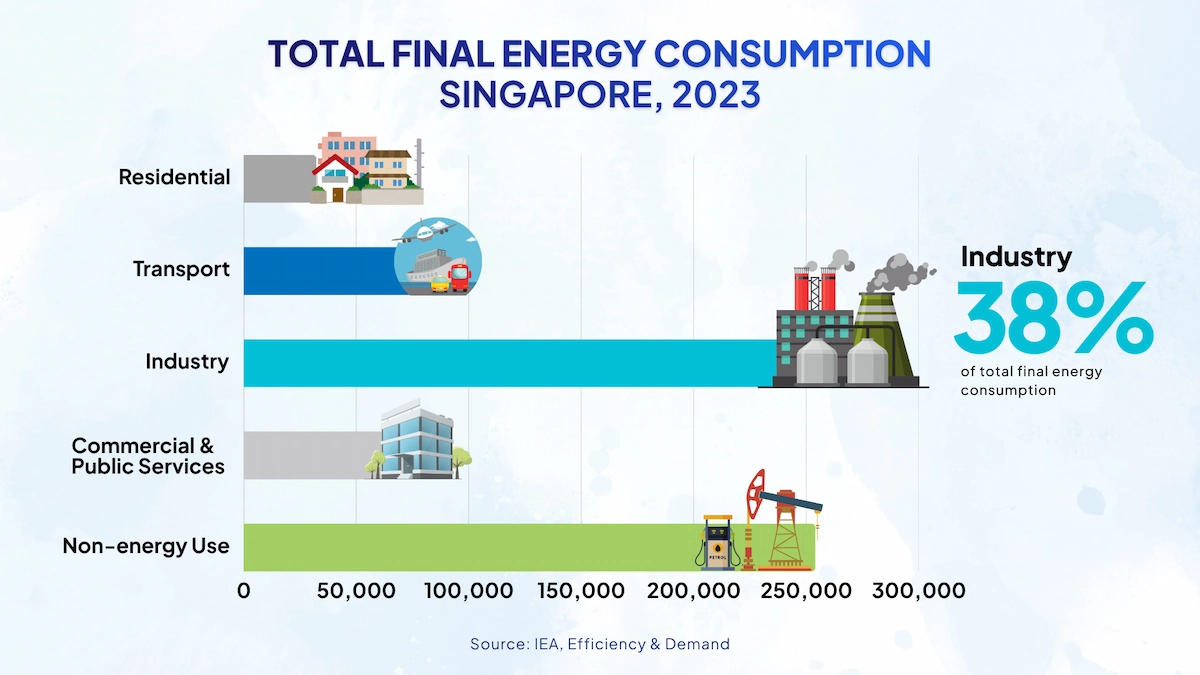
According to the International Energy Agency (IEA), Singapore’s industry sector accounted for 38% of its total final energy consumption in 2023, or 287,447 TJ. This figure is followed by non-energy use (33.5%), transportation (12.1%), commercial and public services (12.1%), and the residential sector.
The energy consumed by Singapore up to recently has been mostly generated from oil and natural gas. Our World in Data reported that in 2024, Singapore consumed 914.6 TWh of oil and 129.82 TWh of natural gas for energy generation.
The problem is that the use of fossil fuels such as oil and gas contributes to greenhouse gas emissions. The IEA noted that the CO2 emissions from fuel combustion in Singapore increased 8%, emitting 45.451 MtCO2 in 2023. Natural gas contributed 50% to the total CO₂ emissions from fuel combustion, followed by oil at 44%.
Moreover, oil and gas are non-renewable energy sources, meaning that Singapore must keep the supply secure to ensure that these major energy sources are secured for the future.
Read also: Renewable Energy in Singapore: Potential and Development
Energy Solutions for Singapore: Energy Supply
To power the nation and address the emissions issue, Singapore is now changing how it produces energy. There are four main energy supply pillars, according to the Energy Market Authority (EMA): solar, regional power grids, low-carbon alternatives, and natural gas.
1. Solar
For Singapore, solar energy continues to be the most promising renewable energy source. Singapore, which is close to the equator, is one of the world's most solar-rich cities.
With an average annual solar irradiance of 1,580 kWh/m²/year, it has comparatively high solar irradiance. This makes Singapore an ideal location to develop solar energy as a power supply solution as well as a clean energy source.
Additionally, Singapore has surpassed its 2030 goal of installing two gigawatt-peak solar power. As a result, it will increase the goal to 3GWp by 2030. The nation will keep optimizing solar deployment on all feasible surfaces and gradually set more challenging goals in the future.
One of the deployment plans is installing solar panels on rooftops, reservoirs, offshore spaces, temporary vacant land, and buildings.
2. Regional Power Grids
As part of the Lao PDR-Thailand-Malaysia-Singapore Power Integration Project (LTMS-PIP), Singapore has started importing renewable hydropower from the Lao People's Democratic Republic (PDR) since June 2022, utilizing pre-existing connections via Thailand and Malaysia.
Along with that, Singapore plans to import about 6 GW of low-carbon electricity by 2035, increasing from the prior target of 4 GW.
3. Low-carbon Alternatives
In addition to solar panels, Singapore also invests in low-carbon energy technologies, such as hydrogen, nuclear energy, geothermal energy, and carbon capture and storage (CCS).
Singapore has a net-zero emissions target by 2050 and is now seeing hydrogen as a potential decarbonization strategy.
It gives the nation the chance to diversify its fuel mix in sectors like transportation and power generation. It may also aid in the decarbonization of power generation and other industries with high emissions if it is produced using renewable energy sources.
Not only hydrogen, but Singapore also sees potential in nuclear energy. The country is still assessing the practicability of nuclear energy, which may take decades to study.
4. Natural Gas
At present, Singapore uses imported natural gas for 95% of its electricity. According to the IEA, Singapore consumed 54,203 GWh of natural gas in 2023 for its electricity generation.
To maintain the energy supply, the nation plans to improve the efficiency and reliability of its natural gas power plants and ensure sufficient generation capacity.
Read also: A Guide to Solar Energy in Singapore: Why Does It Matter?
Energy Solutions for Singapore: Energy Reset
In addition to energy supply, Singapore also seeks to pursue renewable choices to tackle climate change through Energy Reset. Consisting of three pillars: Green Energy, Green Transport, and Green Buildings, Singapore aims to utilize cleaner energy sources across all sectors.
1. Green Energy
Singapore projects to optimize solar panel deployment. Recently, the nation has installed 60 MWp of inland floating solar PV at Tengeh Reservoir. Yet, since solar power is prone to weather conditions, Singapore uses an Energy Storage System (ESS) to support grid resilience.
As mentioned above, Singapore also explores opportunities to pursue low-carbon energy. Singapore unveiled its National Hydrogen Strategy in October 2022, intending to use hydrogen as a primary decarbonization strategy.
2. Green Transport
Singapore has a bold vision of running on cleaner energy for all vehicles across the nation by 2040. The Singaporean government encourages the use of public transportation and a transition to more sustainable vehicles.
In line with EV adoption, Singapore aims to have 60,000 EV charging stations by 2030. By 2025, all HDB towns would be EV-ready.
3. Green Buildings
The nation releases the Green Building Masterplan as a part of the Singapore Green Plan 2030. Launched in 2006, Singapore's first Green Building Masterplan encouraged developers to incorporate sustainability from the beginning of a building's life cycle.
"Build Our Green Future Together," the fourth edition of the Singapore Green Building Masterplan, was issued on March 4, 2021, during the Committee of Supply discussion of the Ministry of National Development.
It aims to establish a leading green built environment industry that can reduce its carbon footprint and offer everyone a sustainable, livable, and healthy built environment.
Aster Chemicals and Energy, #YourGrowthPartner for Solar Energy
Aster Chemicals and Energy Pte. Ltd. (Aster) is a subsidiary of Chandra Asri Group based in Singapore, serving various businesses, such as energy, engineering, fuels, petrochemicals, ports and terminals, specialties, and sustainable products.
To empower communities and expedite the energy transition in support of Singapore's sustainability 2030 goals, Aster is revolutionizing the energy landscape in Singapore and the surrounding area through solar innovation and sustainable solutions.
In addition to energy solutions, Aster also has a strong position in the petrochemical industry, as we produce building blocks for various industries.
We provide butadiene, ethoxylates, ethylene, HDPE, and other chemicals for midstream and downstream production.
So, if you are looking for a petrochemical and energy company in Singapore, be sure that Aster and Chandra Asri Group are on your list. Contact us now for a consultation!
Read also: An Overview of Vietnam's Renewable Energy Transitions