

29-06-2026
What Is Power Factor Correction? Here's How It Works!
By Chandra Asri Group Editorial Team
Electricity is one of the most crucial elements in industry and the household. Electricity use in the industrial sector is typically much higher because almost all operational processes rely on it.
However, to reduce operational costs, electrical energy should be managed efficiently. This is where power factor correction plays its role. To understand more about power factor correction, explore the following explanation.
What Is Power Factor Correction?

Power factor correction (PFC) is a method for improving power factor and quality. PFC can reduce the load on power distribution systems for more efficient use and lower operating costs.
Before learning further about PFC, let’s take a closer look at what power factor is. Power factor is the ratio between active power (kW) and reactive power (kVA). Active power is used to perform useful work, while reactive power is the total amount of power supplied from the electrical grid.
The power factor ranges from 0 to 1. The power is considered efficient if its value is closer to 1. However, in practice, it is almost impossible to receive a perfect 1. Therefore, 0.9 is generally good and considered efficient.
Power factor can decrease due to the use of inductive electrical equipment, such as welding machines, cooling systems, transformers, and electric motors.
This inductive electrical equipment consists of both active and reactive components. Reactive components do not produce useful work but are needed to maintain the equipment's magnetic fields.
Therefore, the total electrical current increases even though the useful power output remains the same. This can reduce the power factor and the electrical system's capacity. As a result, the distribution of electricity becomes less efficient, potentially leading to financial disadvantages, especially for industries that rely on electrical energy.
Power factor correction helps reduce the reactive components of electrical current by supplying the required reactive power locally.
This process reduces the total current drawn from the power grid, thereby increasing electrical efficiency. Furthermore, this method can minimize heat losses and lower operational costs associated with electricity use, particularly for industries that use electricity on a kVA basis.
Read also: Electrical Wiring Diagram: Functions, Forms, and How to Create Them
How Power Factor Correction Works
As previously stated, PFC supplies the reactive power locally rather than drawing it from the electrical grid.
PFC helps reduce the total current and maintain the power factor closer to 1. Furthermore, PFC can also balance reactive power demands by inductive pressure.
In general, PFC can also be achieved by installing a capacitor bank. This supplies the leading reactive current that balances the lagging reactive power demands by inductive electrical equipment.
Related to PFC, there are several methods commonly used in the industrial sector, including:
- Fixed capacitor bank: Capacitors are installed permanently on electrical loads. This method is ideal for locations with stable and predictable loads.
- Automatic power factor correction: This system adjusts the number of active capacitors based on reactive power requirements. This method is suitable for locations with dynamic and fluctuating electrical loads.
- Active power factor correction: This method uses electronic controllers that continuously monitor current and voltage levels. Then, reactive power is supplied based on real-time requirements. This method is also well-suited for dynamic loads.
Advantages of Power Factor Correction
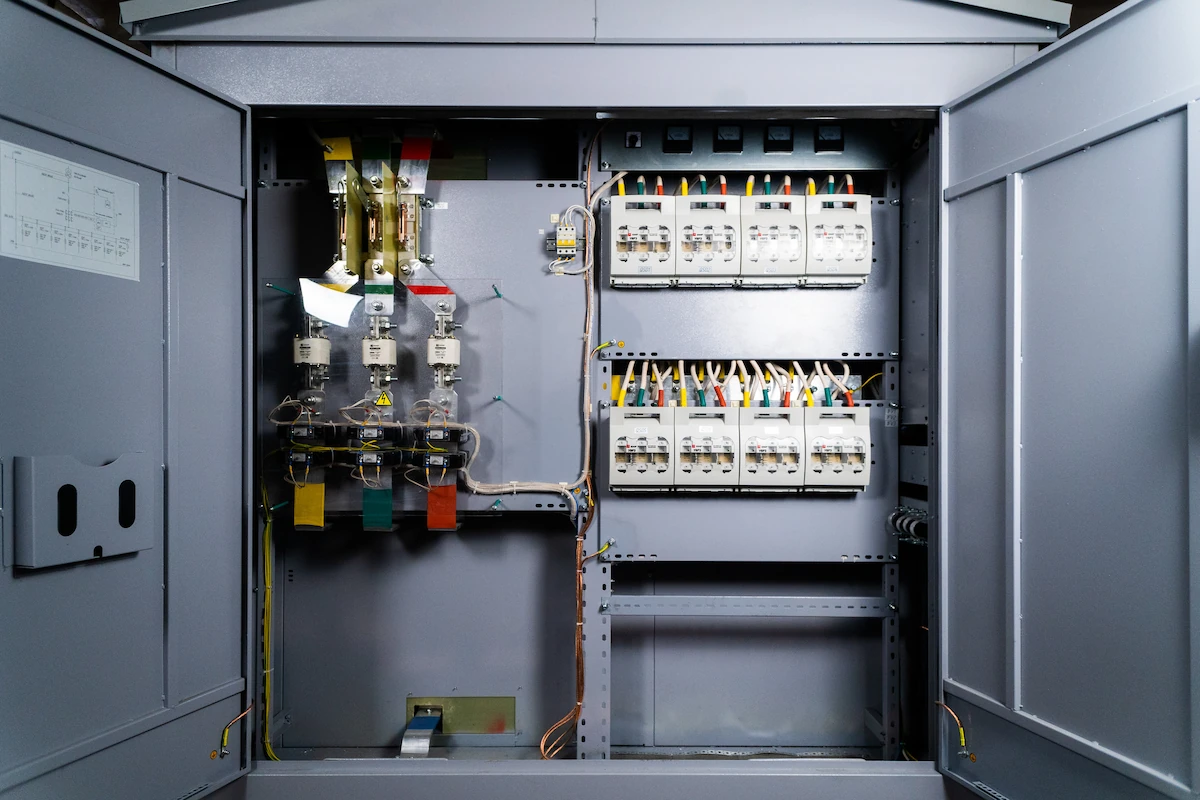
Power factor correction offers various advantages for users, such as:
1. Improving Energy Efficiency
PFC ensures that electrical power is supplied efficiently for useful work and is not consumed solely as reactive power. This can improve energy efficiency in the operational area.
2. Increasing Available Power
PFC that is installed in the low voltage, which can increase power on the secondary transformer MV/LC. As a result, electrical installation can become more optimal.
3. Reducing Electricity Costs
The low power factor forces the electrical system to work harder than usual. This condition can lead to energy loss and raise electricity costs.
Therefore, PFC is used to improve power factor, allowing more efficient use of electricity and lowering operational costs.
4. Increasing Capacity without Upgrade
By reducing the reactive component of the electrical current, PFC can help reduce loads on transformers, cables, and switchboards. This allows the installation of new equipment or expansion without a massive upgrade to the infrastructure.
5. Extending Equipment Lifespan
A power factor that is close to 1 indicates that electrical equipment is operating under lower stress. Therefore, conductors, transformers, and motors generate less heat, extending their service life and reducing maintenance needs.
6. Stabilizing Voltage and Power Quality
Balanced reactive power can stabilize voltage and fluctuations that may cause wear, overheating, and unexpected power interruptions. PFC can also reduce the waveform when combined with harmonic filters.
Read also: Power Plants: Definition, Types, & Examples
Trust Chandra Asri Group for Reliable Industrial Power!
Electrical energy has become a fundamental need in the industrial sector. For a more optimal operational process, reliable and efficient power is required.
Chandra Asri Group, as a provider of energy solutions, chemicals, and infrastructure, presents three pillars of energy infrastructures, including power generation, electricity supply, and renewable energy solutions.
Through its subsidiary, PT Krakatau Chandra Energi (KCE), we can supply electricity to the Krakatau Industrial Area, covering more than 2,000 hectares.
KCE’s electricity supply services are supported by power generation facilities totaling 120 MW of installed capacity. KCE serves 200+ industrial customers and 1.500+ residential customers.
For electrical services, we operate through three business segments: engineering, procurement, and construction (EPC), operation and maintenance (O&M), and transformers and electric motor repairs and overhaul services.
Furthermore, our renewable energy solution includes solar power system installations, such as Solar On Grid, Solar On Grid with Battery Backup System, Solar Off Grid, and Solar Hybrid. As of 2025, the capacity of our solar power plants has reached 11 MWp.
So, do not hesitate to entrust your company’s electrical energy needs to Chandra Asri Group and KCE, #YourGrowthPartner!
Read also: Understanding Battery Energy Storage System (BESS) & Its Uses