
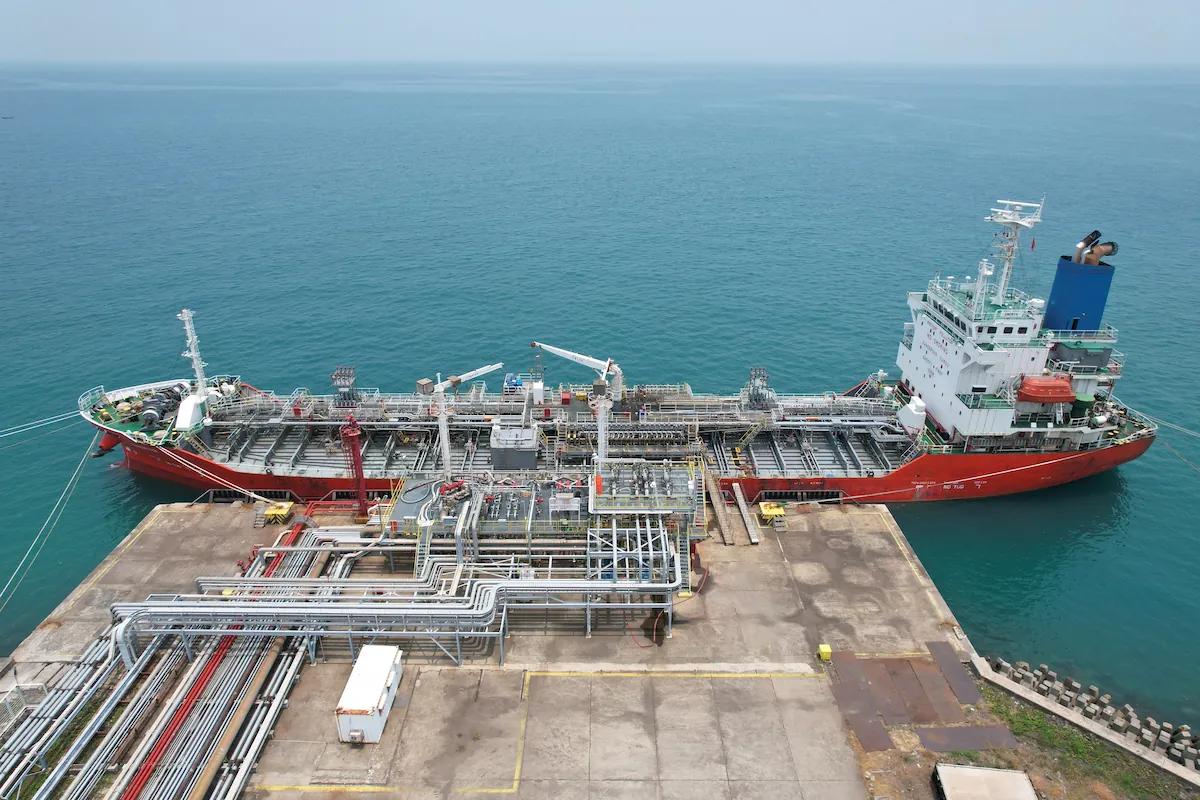
23-06-2026
Marine Loading Arm: Definition, Function, and How It Works
A marine loading arm (MLA) is a piece of equipment used to transfer liquid or gaseous products from a vessel to a dock or port. MLAs are commonly used in the petrochemical industry to transfer chemicals safely.
This article discusses the function of a marine loading arm and its components. Read on for more information.
What Is a Marine Loading Arm?
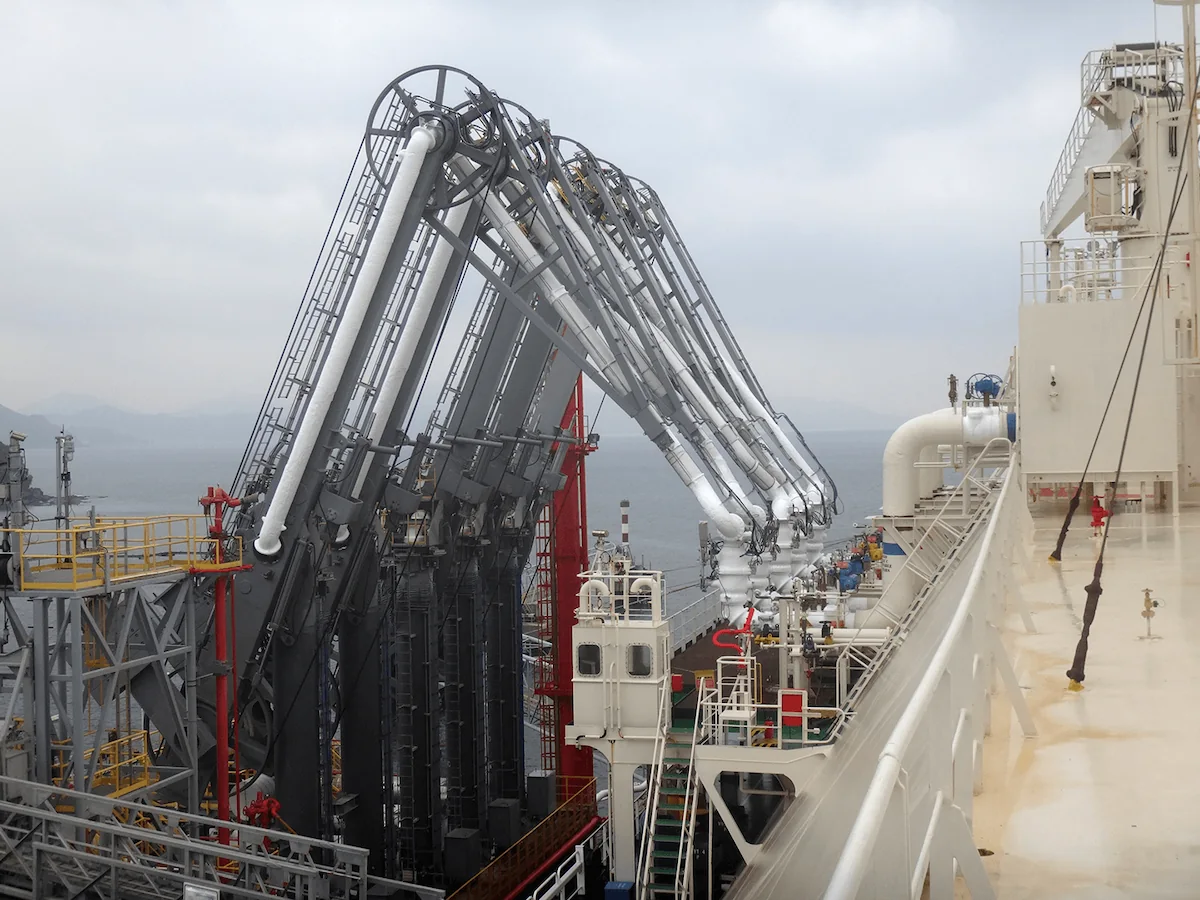
A marine loading arm (MLA) is a mechanical “arm” composed of joints and rigid steel pipes. The MLA connects a ship to the onshore piping network, enabling the transfer of gases and liquids easily and safely.
Typically, MLAs can be found at petrochemical terminals, LPG and LNG export facilities, chemical ports, and chemical plants.
An MLA differs from standard transfer hoses because it can handle large volumes of chemicals at high pressure. Furthermore, an MLA can adapt to a ship’s movements during loading and unloading, as well as to varying wave and weather conditions.
A marine loading arm is hydraulically operated and equipped with an Emergency Release System (ERS). Thus, the loading and unloading process can be faster and safer.
Before the system is disconnected, the MLA must be purged with high-pressure air (for diesel and gas oil) or using a pump (for kerosene and gasoline) to expel any remaining chemicals.
Interestingly, the MLA can handle a wide variety of chemicals with varying viscosities and temperatures.
Read also: Uses of Chemical Storage Tanks and How to Choose Them
Components of a Marine Loading Arm
A marine loading arm (MLA) consists of several components, including:
1. Arms
An MLA has two main arms: one connected to the onshore piping system and the other to the ship’s hull. These arms are connected by swivel joints that allow movement in various directions.
2. Counterweight System
The MLA’s arms are heavy, so they must be equipped with a counterweight or a hydraulic balancing system to prevent the arms from bearing excessive loads.
This counterweight system also enhances safety by ensuring the equipment remains balanced and stable throughout the operational process.
3. Swivel Joints
Swivel joints are key components of an MLA because they provide a wider range of motion. These joints also serve to maintain the fluid transfer path and prevent leaks while the arms are moving.
4. Control System
The MLA is equipped with an advanced control system that manages the equipment’s movements. This system typically includes automated features to ensure precise movements and minimize accidents.
5. Emergency Release System (ERS)
The ERS is a system that controls the MLA arm to automatically detach in an emergency. This system also seals both ends of the arm to prevent fluids or gases from spilling when the arm is released.
6. Quick Connect-Disconnect Coupler (QCDC)
The QCDC allows the MLA to be connected to the ship’s manifold. There are two types of QCDC: manual and hydraulic.
7. Vapor Return Line
For materials that produce vapor during processing, such as crude oil, you need to install a vapor return line to prevent pollution and ensure worker safety.
Read also: Get to Know a Container Port, Its Functions, and Charges
How a Marine Loading Arm Works
During the loading and unloading of chemical products, the marine loading arm operates in the following stages:
- The ship docks at the port: The ship enters the berthing area. Here, the MLA arm is in the “resting” position.
- Arm positioning: The operator positions the MLA arm until it connects to the ship’s manifold. This process is carried out using a bolted coupling or a quick-connect coupling. Then, a seal is installed to prevent leaks.
- Balancing the system: Once the MLA arm is connected to the ship, you need to install a counterweight system and swivel joints so that the arm can follow the ship’s natural movements. This ensures that even if the waves rocked the ship, the arm’s connection remains secure.
- Product distribution: The pump pushes the product through the piping network to the arm and into the tanks on board the vessel.
- Vapor control: If vapor is generated during product distribution, you can collect it and return it to shore via the vapor line.
- Completion phase: Once the distribution process is complete, the MLA arm is disconnected from the ship’s manifold and returned to its storage location for future use.
In the event of an emergency or if the ship is rocking violently to the point of endangering the distribution, the ERS system will automatically activate, the arms will immediately detach, and both ends of the pipe will be sealed to prevent the liquid from flowing out.
Advantages of the Marine Loading Arm
The marine loading arm (MLA) offers several advantages that have led to its increasing use in the petrochemical sector, including:
- Supports safer operations: MLAs are equipped with automated and precise systems that reduce the risk of human error. They also feature an ERS that activates immediately in emergencies.
- Enhances process efficiency: MLAs can quickly transfer chemical liquids or gases, so ships do not need to remain docked for too long, and subsequent business processes can proceed immediately.
- Greater durability: MLA is more durable than standard hoses, even after thousands of chemical transfer operations.
- High adaptability: MLA can adapt to a vessel’s natural movements without spilling chemical liquids.
- High environmental safety: MLA features advanced liquid transfer technology that minimizes the risk of chemical leaks or spills into the ocean.
Port Services and Chemical Raw Material Storage from Chandra Asri Group
Chemicals, whether in gas or liquid form, must be managed carefully and in accordance with standards to prevent damage to raw materials and environmental pollution.
Therefore, if your company is planning to transport chemicals by sea, be sure to include port and storage services by Chandra Asri Group in your plans!
Through PT Chandra Pelabuhan Nusantara (CPN) and PT Redeco Petrolin Utama (RPU), the Chandra Asri Group serves a range of chemical storage needs equipped with marine loading arms.
CPN, as a subsidiary, operates a 35+ hectare facility located in Cilegon and manages three jetties serving ships, including:
- Jetty A for naphtha, LP propylene, and py-gas vessels with a capacity of 80,000 DWT.
- Jetty B for HP propylene, LPG, and naphtha vessels with a capacity of 6,000 DWT.
- Jetty C for ethylene, py-gas, raffinate-1, butadiene, naphtha, and PFO vessels with a capacity of 10,000 DWT.
CPN also manages over 50 tanks with a total capacity of over 500,000 m³, including atmospheric and pressurized tanks.
In addition to CPN, port solutions and chemical raw material storage are also operated by RPU. As #YourGrowthPartner, RPU serves 2 jetties with a water depth of 10 meters for vessels with a maximum deadweight of 35,000 DWT and a length overall (LOA) of 200 meters.
Furthermore, RPU operates over 70 tanks with a capacity of over 125,000 kiloliters, a centralized fueling station, a customer order service system, and international-standard safety practices.
For chemical storage and handling solutions, trust the Chandra Asri Group!
Read also: Understanding Breakwater: Definition, Function, and Types