
30-06-2026
Carbon Offset: Understand Its Benefits and Project Examples
By Chandra Asri Group Editorial Team
There are many ways organizations and individuals can reduce carbon emissions, such as carbon offsetting. This mechanism allows companies and individuals to fund verified carbon projects that reduce or prevent greenhouse gas (GHG) emissions.
This article explores carbon offsetting, including how it works, its benefits, and its role in mitigating climate change and protecting the planet.
What exactly is carbon offsetting? Why does it remain an important option in corporate decarbonization strategies? Read on to gain a deeper understanding of the concept.
What Is Carbon Offset?
In reality, even with decarbonization efforts, some greenhouse gas (GHG) emissions cannot be eliminated from business operations or organizational activities. These are commonly referred to as residual emissions.
To compensate for these residual emissions, companies can use carbon offsetting, a mechanism that offsets emissions by purchasing carbon credits from projects that reduce or remove GHG emissions.
These emission reduction or removal initiatives are known as carbon projects. They can be developed by external organizations or by the companies themselves.
To ensure their integrity and credibility, carbon projects must undergo validation and verification by independent third-party bodies in accordance with recognized standards and methodologies.
Once the validation and verification process is complete and approved, the resulting carbon credits are recorded in a carbon registry before they can be issued and traded.
Companies and individuals can purchase carbon credits through the carbon market. In Indonesia, carbon credit trading is conducted through IDXCarbon, the carbon exchange operated by the Indonesia Stock Exchange (IDX) under the supervision of the Financial Services Authority (OJK).
Furthermore, research published in the journal Scientific Data highlights that carbon credits have become one of the key mechanisms for channeling financing to climate change mitigation efforts worldwide.
Read also: Sustainability Reports and Publications
Why Is Carbon Offsetting Important?
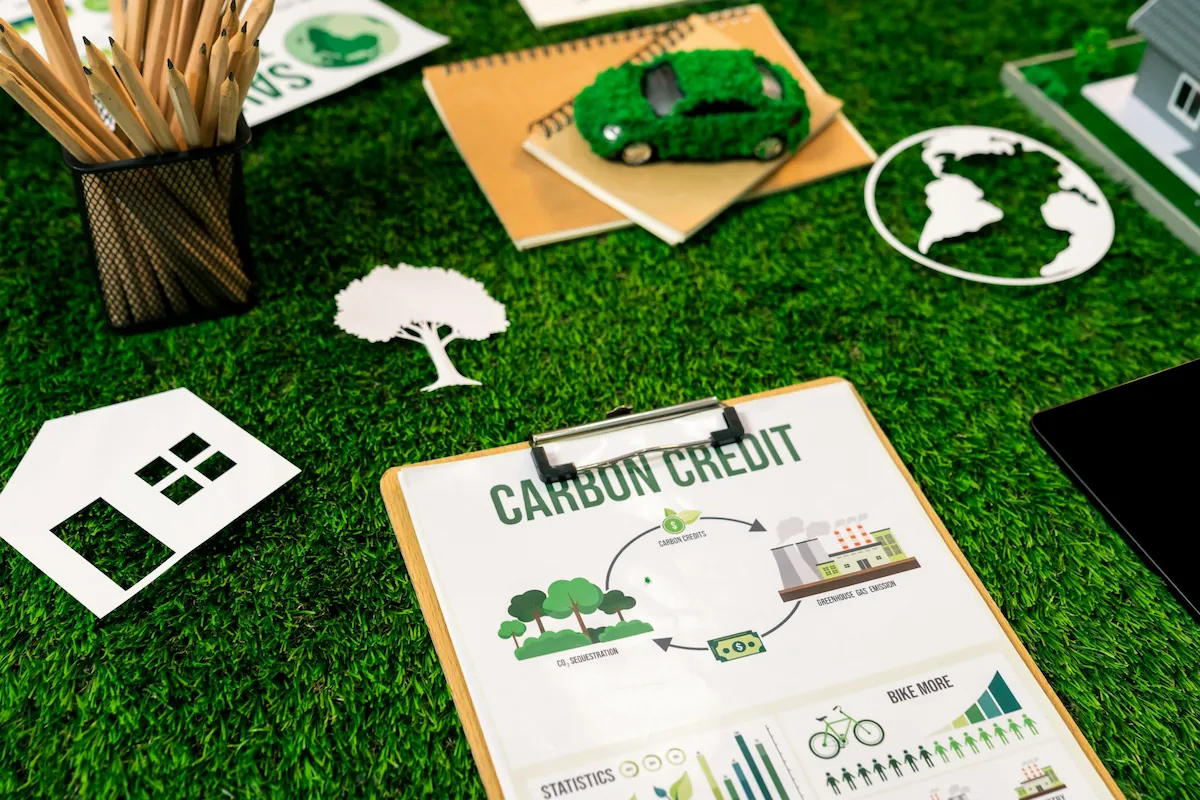
Carbon offsetting plays a significant role in reducing atmospheric carbon emissions. Here are some of the key reasons why it matters:
1. Supports ESG Commitments
Environmental, Social, and Governance (ESG) has become a key consideration for companies, investors, and other stakeholders when evaluating an organization's sustainability performance.
Through carbon offsetting, companies can demonstrate their commitment to managing their environmental impact while supporting projects that reduce or remove greenhouse gas (GHG) emissions. Carbon offsetting complements broader sustainability strategies, including decarbonization initiatives and net-zero emissions targets.
By incorporating carbon offsetting into their climate strategy, companies can build more responsible business practices and strengthen their contribution to addressing climate change.
2. Compensates for Hard-to-Abate Emissions
Despite ongoing efforts to improve energy efficiency and reduce emissions, some residual emissions remain difficult, or currently impossible, to eliminate due to technological, operational, or economic constraints.
In these cases, carbon offsetting serves as a complementary solution by directing funding to projects that reduce, avoid, or remove greenhouse gas (GHG) emissions, helping to compensate for emissions that cannot yet be eliminated.
3. Supports Funding for Climate Change Mitigation Projects
Purchasing carbon credits helps channel funding to a wide range of climate change mitigation projects, including forest conservation and restoration, renewable energy development, waste management, and carbon capture technologies.
As a result, carbon offsetting not only benefits carbon credit buyers but also supports the development of climate solutions that generate positive environmental and social co-benefits.
4. Enhances Corporate Reputation
A commitment to carbon offsetting and other emissions reduction initiatives demonstrates a company's dedication to supporting the transition to a low-carbon economy.
In addition to meeting the expectations of investors, customers, and regulators, these efforts can strengthen stakeholder trust and enhance the company's reputation as an environmentally responsible, sustainability-driven organization.
How Carbon Offsets Work
In general, the carbon offsetting process involves the following steps:
- Calculate your emissions: First, measure the GHG emissions generated by your operations. You can use one of the many carbon footprint calculators available on search engines.
- Purchase carbon credits: Once your emissions have been calculated, you can purchase carbon credits from eligible providers. Typically, one carbon credit represents one metric ton of carbon dioxide equivalent (tCO₂e). The carbon credits and the projects that generate them should be independently validated and verified in accordance with recognized standards and methodologies.
- Retire the carbon credits: Carbon credits are then retired to ensure they are used transparently and only once. Retirement is carried out through a carbon registry, which records that the credits have been claimed and permanently removed from circulation, preventing them from being traded again. This process helps avoid double-counting.
- Report your actions: For companies, carbon offsetting initiatives can be documented and disclosed in sustainability reports as part of broader climate and environmental reporting.
Read also: 9 Plastic Waste Processing Solutions, Effective and Safe!
Types of Carbon Offset Projects

In general, carbon projects fall into two main categories, namely Nature-Based Solutions (NBS) and Technology-Based Solutions (TBS). Here are some common examples:
1. Waste Management
One of the most common types of carbon offset projects is waste management. These projects include a wide range of activities, such as waste decomposition at landfills and agricultural waste treatment.
The primary objective of waste management projects is to reduce, destroy, or capture and utilize methane generated from livestock manure or organic waste.
Methane is produced when organic materials, such as food waste, agricultural residues, or animal manure, decompose through an anaerobic process, meaning decomposition by microorganisms in low- or no-oxygen conditions.
If left unmanaged, methane released into the atmosphere can significantly contribute to global warming because it has a much higher global warming potential than carbon dioxide.
With appropriate technologies and management practices, methane can be captured, flared, or converted into a valuable energy source. It can then be used to generate electricity, produce alternative fuels, or supply biogas for residential and industrial applications.
2. Afforestation and Reforestation
Afforestation (establishing forests on land that was not previously forested) and reforestation (restoring forests that have been cleared or degraded) are also common types of carbon projects. According to an MIT report, forests can store between 10 and 1,000 tons of carbon per hectare.
By expanding forest cover through afforestation and restoring degraded forests through reforestation, these projects help ecosystems absorb more carbon dioxide from the atmosphere. In addition, reforestation projects can restore biodiversity and support the recovery of habitats lost to deforestation.
3. Carbon Capture and Storage (CCS)
As climate technologies continue to evolve, innovations for reducing greenhouse gas emissions are emerging. One of the most promising is Carbon Capture and Storage (CCS).
In the context of carbon credits, certain CCS projects that meet approved methodologies can generate credits by capturing carbon dioxide (CO₂) and permanently storing it.
4. Renewable Energy Projects
Companies can also invest in projects that support the development of renewable energy, such as hydropower, wind power, and solar power. These projects are among the most widely implemented carbon offset initiatives worldwide, as they help replace fossil-fuel-based energy sources with cleaner, low-carbon alternatives.
Chandra Asia Group’s Efforts in Managing Industrial Carbon Emissions
Chandra Asri Group implements the ABCD Strategy to mitigate the impacts of climate change caused by greenhouse gas (GHG) emissions. It consists of the following pillars:
- A – Abate existing emissions through energy efficiency: Improve energy efficiency through process modifications, equipment replacement, waste heat recovery, digitalization, loss reduction, energy consumption management, and enhanced operational efficiency.
- B – Balance future emissions by incorporating green businesses: Expand into low-emission business opportunities, scale up renewable energy initiatives, and explore the development of green and sustainable products, recycled plastics, new chemical production pathways, and nature-based business solutions.
- C – Control emissions through green technology application: Assess and implement low-carbon technologies, including low-carbon fuels such as blue and green hydrogen, refuse-derived fuel (RDF), and carbon capture, utilization, and storage (CCUS) in collaboration with technology and service providers.
- D – Decarbonize through nature-based solutions: Support nature-based solutions, including forest conservation and restoration, regenerative agriculture, and blue carbon initiatives, to enhance carbon sequestration and ecosystem resilience.
Chandra Asri Group will continue to develop and invest in a range of emissions-reduction and carbon-credit initiatives to support the achievement of its climate goals.
As #YourGrowthPartner, our commitment to sustainability extends beyond carbon emissions. We also take a comprehensive approach to environmental stewardship by:
- Reducing greenhouse gas (GHG) emissions, hazardous air emissions, and ozone-depleting substances from our operations.
- Developing and implementing a net-zero emissions strategy.
- Reducing and effectively managing wastewater.
- Investing in clean technologies.
- Implementing robust environmental management systems.
- Raising stakeholder awareness of the importance of environmental sustainability.
- Complying with all applicable local and national environmental regulations.
That concludes the information on carbon offsetting that you need to know. While industrial operations are essential, minimizing their environmental impact is equally important.
Hence, a wide range of sustainability mechanisms has been implemented to support long-term climate action.
Chandra Asri Group, as a leading provider of chemical, energy, and infrastructure solutions in Southeast Asia, is committed not only to delivering the best services and products but also to taking responsibility for environmental sustainability in accordance with circular economy and ESG principles.
Read also: What Is Circular Economy: Definition, Roles and Implementation!