
Container Ships: Definition, Types, and How They Work
By Chandra Asri Group Editorial Team
25-12-2025
A ship is one of the transportation modes commonly chosen by companies, exporters, or importers. Some ships you may already be familiar with include tanker ships, barges, and container ships.
For a large shipment, a container ship can be a solution. Then, what are the types of container ships? Read this article until the end to find the complete information.
What Is a Container Ship?
A container ship usually carries goods and passengers. It typically delivers goods across the lands and continents. Similar to other vessels, container ships must be designed following the ISO standards. It has various standardized sizes, with 20-foot and 40-foot ships becoming the most common ones.
When you use a container ship, you can transport goods multimodally, meaning that the containers can be moved from the ship to the trucks or cargo trains when it reaches land.
This undoubtedly benefits sea freight because sea transportation is the foundation of global business. In fact, 80% of goods traded globally are delivered using sea transportation.
A container ship has some advantages, such as carrying more goods in one trip, increasing international trade efficiency, and allowing companies to reach a wider market.
Read also: What Is a Barge, Its Functions, Types, and Benefits
How a Container Ship Works
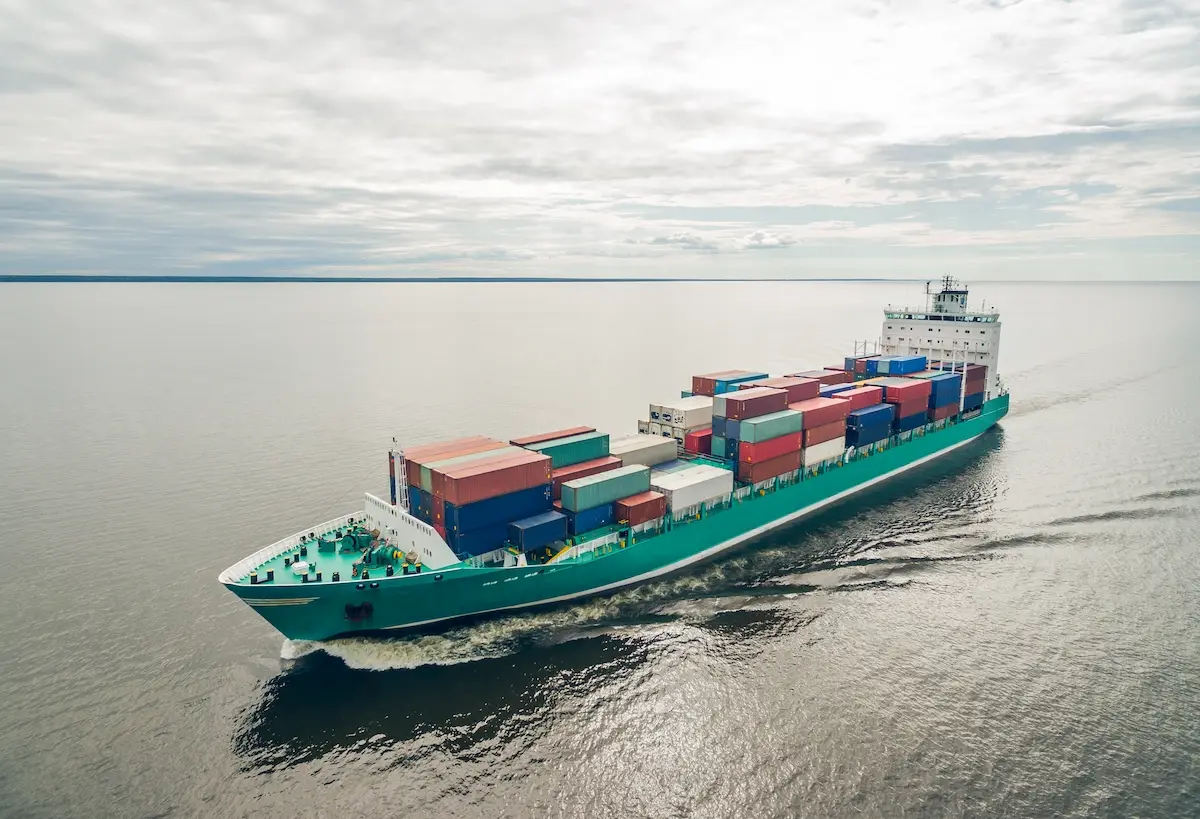
A container ship will go through several stages, from departure to arrival. Here is how a container ship transports its goods to the customers:
1. Pre-Departure
The container ship trip begins when goods are ordered from the manufacturer. The manufacturer will collaborate with a freight forwarder to deliver the goods to the customer.
A freight forwarder is a party responsible for moving goods across countries by any mode of transportation, such as trucks, ships, trains, or planes.
When goods are shipped by container ship, consumers need a bill of lading containing important information, such as the quantity of goods, their description, the origin, the destination, and the costs. Furthermore, it can also serve as proof of ownership of the goods.
2. Goods Loading
Containers from trucks will be loaded onto the ship after a freight forwarder completes the administrative requirements and sets the delivery routes. The containers will be stacked by the port workers using a crane.
During this time, a freight forwarder will give the shipment details to the shipping company. This company will send the details to the destination port authority.
3. Trip
Once the containers are loaded onto the ship, the trip has begun. Before reaching the destination port, the shipping company’s global documentation center or the ship captain will ensure that the port authority has the important details about the shipment and allows the ship to anchor.
4. Unloading the Goods
Upon the arrival of the container ship at its destination port, the authorities will prepare an area for the ship to dock. This area is usually equipped with port cranes and dock workers who are ready to unload the cargo.
Then, customs officials will check the shipping documents after all containers have been unloaded at the port. If the information on the containers matches that on the documents, the containers will be carried by truck to a distribution center and delivered to the customer’s address.
Read also: What Is Vessel? Definition, Types, & Difference with Ships
Types of Container Ships
Container ships can be categorized based on size (Twenty-foot Equivalent Unit/TEU) and type. Here are the types:
1. Panamax
Panamax has a capacity of 5,000 TEU, a length of 965 feet, and a width of 106 feet. This ship was initially built in the 1980s and was designed to fit the old Panama Canal’s width.
2. Feedermax
Feedermax has a capacity of 1,000–3,000 TEU. It usually delivers to good inland areas and through narrow lanes. It is also used for carrying special goods, such as cargo that does not fit the standard container ship and dangerous raw materials.
3. Post-Panamax
Post-Panamax ships have a capacity of around 6,000–10,000 TEU. Initially, many ships longer than 984 feet could not pass through the Panama Canal in the 1980s. That is why these ships are called Post-Panamax, especially after the Panamax ships were built.
However, since the Panama Canal has now been expanded, the term "Post-Panamax" now refers to ships that are larger than Panamax ships and cannot pass through the old Panama Canal.
4. Ultra Large Container Vessel (ULCV)
An Ultra Large Container Vessel (ULCV) is a large container ship that has a capacity of up to 14,000 TEU or more. It has a length of 1,312 feet and a width of about 193.5 feet.
It might be too big to pass through the Panama Canal, but it can transit through the Suez Canal. You can see this ship in busy ports, such as in Northern Europe or Shanghai, China.
5. New Panamax
New Panamax, or Neo Panamax, is a ship designed to adapt to the Panama Canal expansion in 2016. Ships with a length of over 1,300 feet and a width of 157 feet can pass through the expanded Panama Canal. The New Panamax ship has a capacity of up to 12,500 TEU.
Parts of a Container Ship
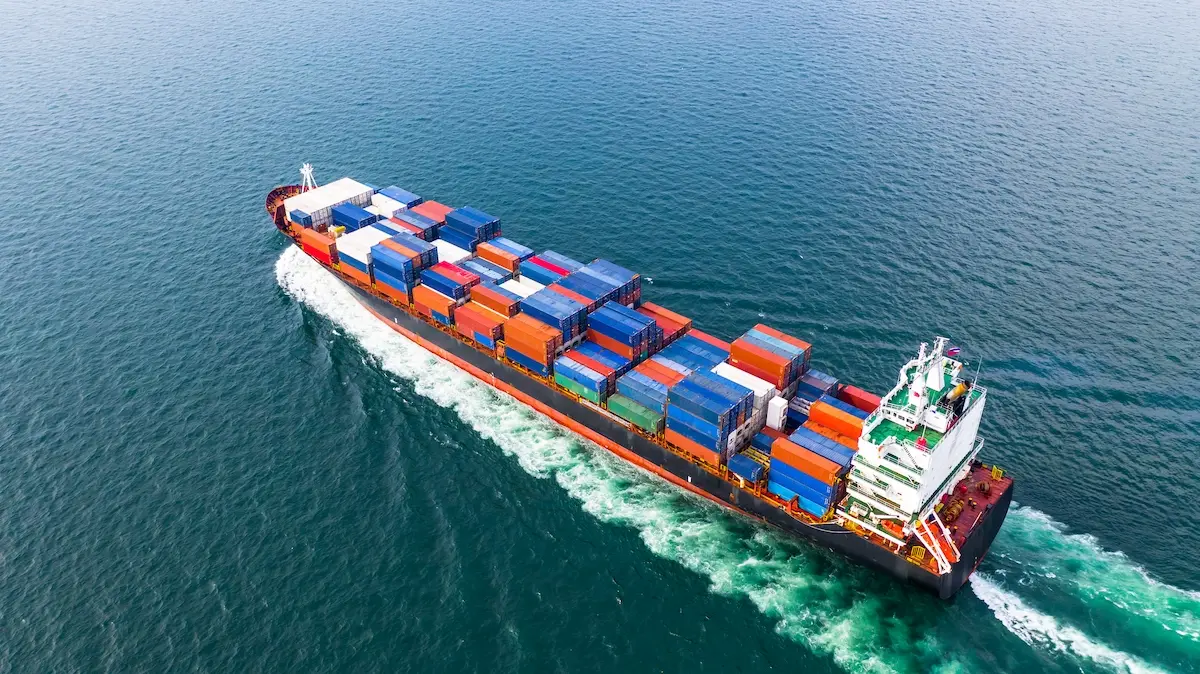
Container ships generally have cranes, cargo holds, bridges, and other parts. The following is a detailed explanation:
- Cranes: Small container ships such as Feedermax usually have cranes on board. However, larger ships rely on cranes installed at the port. These cranes are specially designed according to the containers being lifted and the size of the ship.
- Ship deck: The deck is a hull cover that can be designed in tiers.
- Accommodation: Accommodation is the living facilities for the ship's crew.
- Cargo hold: The cargo hold is located in the hull of the ship and is used to store cargo. It is usually equipped with a cover that can protect the containers.
- Keel: It provides structural strength to the ship and supports it.
- Bridge: It contains the engine and controls for steering the ship. This is where the captain and crew control the ship's speed.
That concludes the information about a container ship you can learn. A container ship plays a crucial role in transporting goods in global trade.
If your company needs sea freight service for chemicals and LPG, you can rely on Chandra Asri Group! As #YourGrowthPartner, we provide vessel services through PT Chandra Shipping International and PT Marina Indah Maritim.
Recently, we have had more than ten vessels with a capacity of 106,650 DWT. This amount can increase in the future.
So, entrust your chemical and LPG logistics needs to Chandra Asri Group!
Read also: Get to Know About Ship Docking: Process and Function
.png&w=3840&q=75)