

Understanding Acid Rain and Its Impact on the Environment
By Chandra Asri Group Editorial Team
29-11-2025
Did you know that one of the causes of worsening greenhouse gas emissions is acid rain? Acid rain contains pollutants that can harm human health. Then, what is the cause, and how is acid rain formed? To find the answer, read this article until the end!
What Is Acid Rain?
Acid rain is a broad term for precipitation (the process of water droplets falling from the atmosphere to Earth) that contains acidic components and falls from the atmosphere to Earth. Acid rain does not always come in the form of raindrops; it can also appear as fog, snow, or even acid dust.
In general, acid rain results from highly acidic water droplets formed by air emissions, such as sulfuric and nitric acids, from manufacturing processes and motor vehicles.
Acid rain, or acid deposition, is categorized into two types: wet and dry deposition. The characteristic of wet deposition is precipitation. This process removes acid in the atmosphere and moves it into the Earth’s surface in the form of rain, snow, or fog.
On the other hand, when there is no precipitation, it is considered dry deposition. Dry deposition is typically in the form of smoke or dust on the Earth’s surface.
In September 2025, the Meteorology, Climatology, and Geophysical Agency (BMKG) analyzed rainwater samples from several areas in Indonesia. BMKG divided the rainwater chemistry into six categories, such as:
- >7: Alkali pH.
- 6,1–7: Well rainwater chemistry, considered neutral.
- 5,6–6: Ideal pH for rainwater.
- 4,1–5,5: Acid rain
- 3–4: High acid rain.
- < 3: Extreme acid rain.
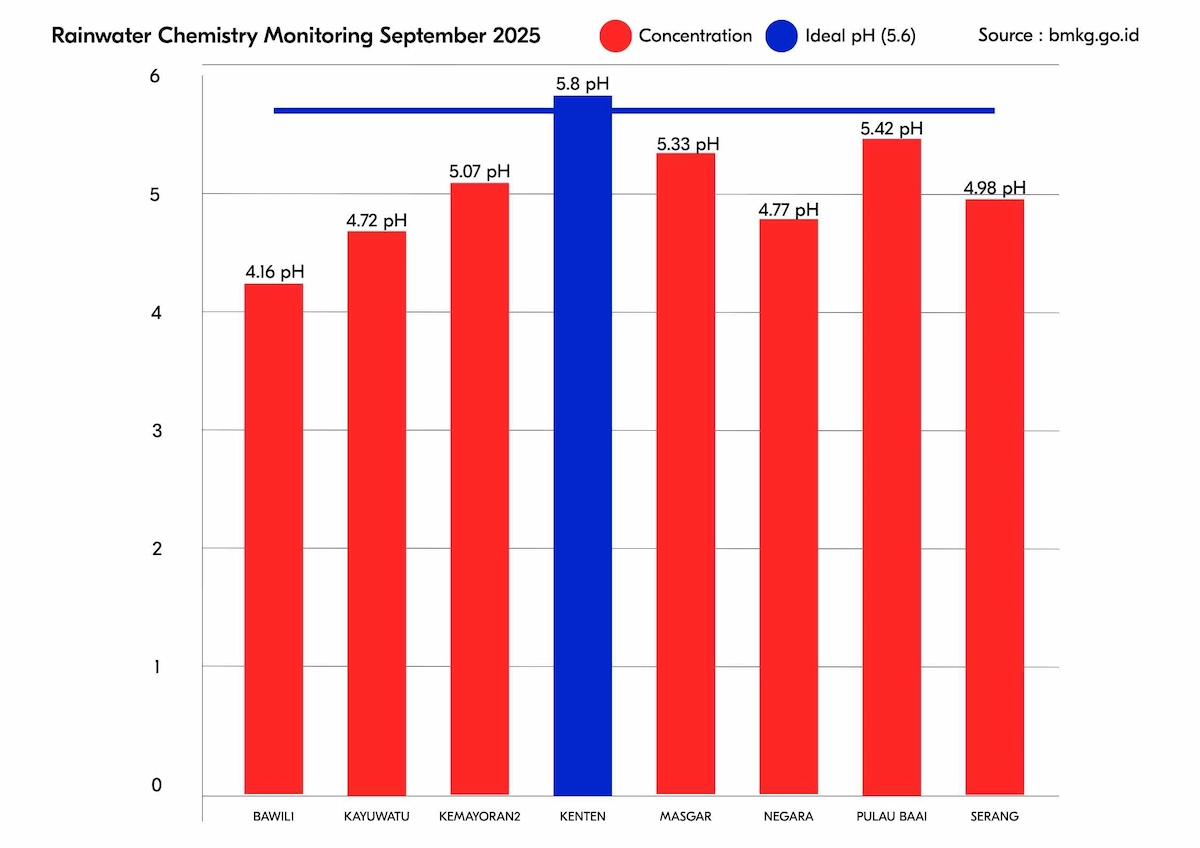
Of eight rainwater samples, only one sample was ideal, which was in Kenten, South Sumatera. However, the other seven areas potentially had acid rain, with pH ranging from 4.16 to 5.42.
How Is Acid Rain Formed?
Acid rain is formed when sulfur oxides and nitrogen oxides are carried by air flow and wind up to the atmosphere. Then, sulfur oxides and nitrogen oxides react with water, other chemicals, and oxygen.
After that, the chemical reaction produces sulfuric acid and nitric acid. These acids dissolve in water and other substances before falling as raindrops, fog, or snow.
The acid in the rain lowers its pH below normal; thus, it is called acid rain. The wind can bring sulfur oxides and nitrogen oxides far away from the initial area, affecting other regions.
Read also: Net Zero Emissions, a Global Solution for Greener Earth
Causes of Acid Rain

The primary causes of acid rain are nitrogen oxides and sulfur oxides emitted into the atmosphere from the combustion of fossil fuels. However, natural activity can also release those substances, such as in a volcanic eruption.
Industries and vehicles commonly emit pollutants. Then, they fly to the atmosphere, far from the initial area. Pollutants mixed with moisture in clouds create acid rain.
That’s why many industries now use low nitrogen oxide burners to reduce the amount of these pollutants. Not only that, but factories have also started using low-sulfur fuels and installing scrubbers to clean exhaust gases (byproducts of factory manufacturing).
For motor vehicles, many now use onboard diagnostics (OBDII) to notify drivers of problems with emission controls. In addition, some cars can now use low-sulfur fuel, emitting fewer pollutants.
Read also: What Is Energy Efficiency? Here are the Benefits & Examples
The Impacts of Acid Rain

Acid rain can affect the environment and humans. Here are some effects of acid rain you must know:
1. Polluting the River and Lake
High acidity levels can accelerate the conversion of elemental mercury into methyl mercury. This type of mercury is extremely deadly because it is a neurological poison.
This conversion usually occurs in swamps with low oxygen levels. River and lake animals may eat phytoplankton or zooplankton contaminated with methyl mercury. The process then continues up the food chain until it reaches humans, where it can cause health problems.
In addition to creating dangerous mercury, acid rain also disrupts the reproductive cycle of river biota. The acidification process can produce aluminum. This is because clay and organic matter in the soil actually contain negative charges.
If the soil is not acidic, these charges are balanced by positive charges in specific plant nutrients, such as potassium and magnesium.
However, when the soil is acidic, the concentration of other non-nutrient elements, such as aluminum and hydrogen, increases, displacing these nutrients. In non-acidic conditions, aluminum can form in soil particles.
Yet as soil acidity increases, clay begins to dissolve, releasing soluble aluminum into the soil. When it leaches into the soil, this water will flow into rivers and lakes.
This aluminum-rich water increases aluminum accumulation on the surface of fish gills, leading to increased mucus secretion and gill clogging. The accumulation also makes the fish's body more acidic, rendering it more susceptible to death.
2. Weakening Forest Ecosystem
Acid rain can make trees more susceptible to environmental stress, increasing their vulnerability to pathogens, insect attacks, and drought. Consequently, forest damage can spread and harm surrounding forests and water ecosystems.
3. Damaging Buildings
Acid deposition can also damage buildings. Typically, buildings made of limestone or marble are more susceptible to damage. When acid rain hits limestone sculptures, the material turns into gypsum, which is easily dissolved by water.
As a result, the statue becomes more prone to decay or collapse. In fact, acid rain can directly dissolve marble and limestone through direct contact. Not only limestone and marble, but acid rain can also damage stone buildings and corrode metals.
4. Affecting Human Health
Being exposed to acid rain is undoubtedly more dangerous than normal rain because the pollutants it contains can harm your health. You can inhale pollutants, which can cause respiratory problems and even a heart attack.
Rainwater that seeps into underground areas can corrode water pipes, contaminating the water with copper and causing severe disease.
That concludes the information you can learn about acid rain. Acid rain has negative impacts on the environment and humans. Thus, you need to prevent it from happening.
One effort to reduce the potential for acid rain is to reduce carbon emissions. Chandra Asri Group, as a leading chemical, energy, and infrastructure solutions company in Southeast Asia, has implemented many initiatives to manage emission levels in accordance with the established limits, including:
- Carrying out energy efficiency programs to reduce fuel consumption.
- Minimizing combustion.
- Using a low-nitrogen oxide burner.
- Reducing VOC gas with the Leak Detection and Repair Program (LDAR).
- Monitoring the nitrogen oxide level with the Continuous Emission Monitoring System.
- Using an Enclosed Ground Flare.
- Utilizing electrostatic precipitators for particulate emission reduction.
So, Chandra Asri Group, as #YourGrowthPartner, not only prioritizes product and service quality but also takes responsibility for the environment.
Read also: How to Stop Global Warming in 7 Easy Ways: Must Note!
.png&w=3840&q=75)